
Nine of eleven AI cloud builders are down 50% from their highs
The claim. The AI build-out trade has split into tiers. The companies writing the cheques sit near their highs; the companies financed to build for them have halved or worse. That is the shape of the 2000 telecom cycle, and the next move depends on contracts and funding, not on sentiment.
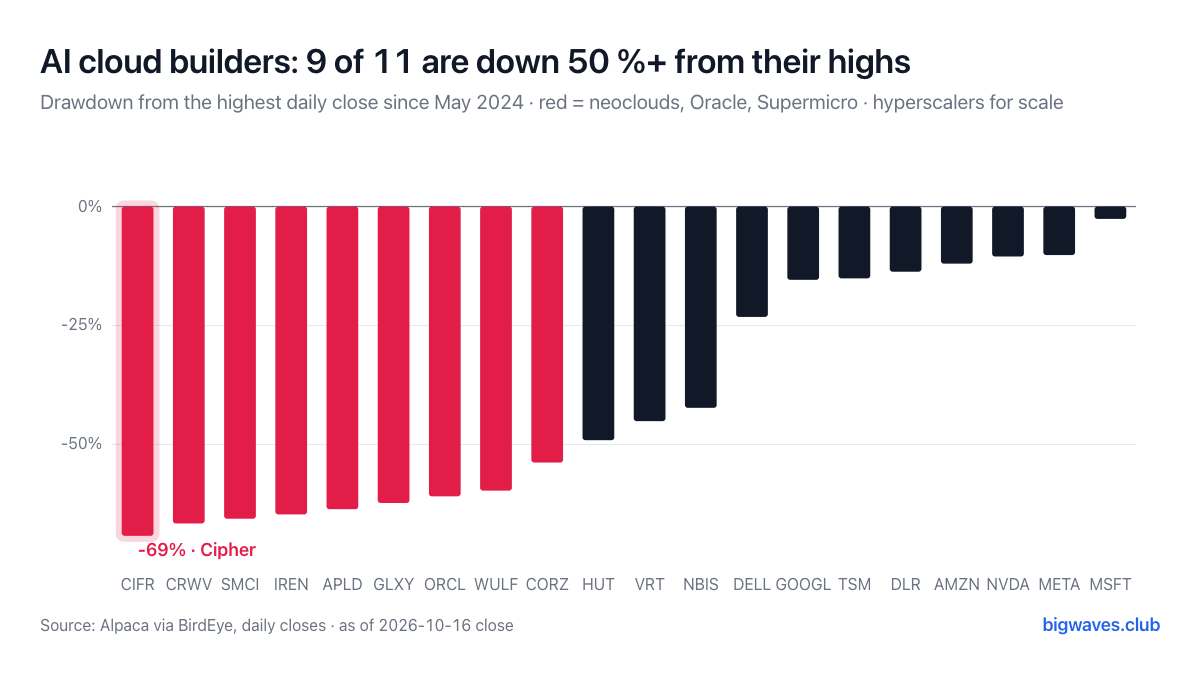 Caption: distance from each name's highest daily close since May 2024. Red bars are the builders, neoclouds plus Oracle and Supermicro, that are 50 percent or more below their peak. Hyperscalers and chip leaders are on the right for scale.
Why
- Nine of eleven builders are down 50 percent or more. Cipher minus 69 percent, CoreWeave minus 67, Supermicro minus 66, IREN minus 65, Applied Digital minus 64, Galaxy minus 62, Oracle minus 61, TeraWulf minus 60, Core Scientific minus 54. Hut 8 at minus 49 and Nebius at minus 42 just miss the line. Source: Alpaca daily closes via BirdEye, as of the Oct 16 close.
- The buyers are not. Microsoft is 2.6 percent off a high set on Oct 13. Meta is minus 10 percent, Nvidia minus 10.5, Amazon minus 12, Alphabet minus 15, TSMC minus 15.
- The peaks share a date. Nebius, Cipher, TeraWulf and Core Scientific all topped on June 18, 2026, within a week of Hut 8, Applied Digital and Vertiv. That is one trade unwinding, not company-specific news. CoreWeave and Oracle are the exceptions, with peaks in mid-2025 and a longer bleed.
- Last week was the acceleration. Builders lost 12 to 34 percent in five sessions: Cipher minus 34, CoreWeave minus 25, Nebius minus 25, Supermicro minus 24, Applied Digital minus 24, Dell minus 23. The hyperscalers lost 1 to 5 percent.
- Year-to-date splits the group. Dell is up 259 percent for the year, Nebius 98, Hut 8 48, because their runs started from low bases. CoreWeave is minus 14 for the year, Oracle minus 34, Cipher minus 39.
What we expect
- Base case (to year-end): no hyperscaler cuts 2027 capex guidance on the late-October calls, and the builders bounce hard but to lower highs. Their equity is now a funding question, how a debt-financed build gets refinanced at a 5.1 percent Treasury yield, rather than a demand question. Signal it is working: a neocloud prices new debt or equity at non-distressed terms, and the group closes a week above its Oct 9 levels.
- Alternative: a hyperscaler trims 2027 capex or a neocloud contract is renegotiated. Then the 2001 path applies: builders 80 to 90 percent below peak, the equipment tier (Dell, Vertiv) catches down, and the hyperscalers finally participate. Signal: any capex guidance cut on the Microsoft, Alphabet, Meta or Amazon calls in the last week of October.
What would change our mind
- The earnings calls. If capex guidance rises again and the builders keep falling, the problem is their balance sheets, not demand. That is worse for them, not better, and it would argue for the alternative case even without a cut.
- Rates. The builders are the most rate-sensitive names in the chain, financed with high-yield debt and GPU-backed loans. A 10-year yield back under 4.75 percent changes the refinancing math before any contract does.
This note is general information and the author's opinion as of the date shown. It is not investment advice and does not consider your situation. The author may hold positions in the securities discussed. Data are from the sources named and may contain errors; past performance does not predict future results. Do your own research.