
Brazil priced a Bolsonaro win. Lula won.
Update, Monday Oct 26 close. The reversal came in full. EWZ closed down 19.8% at $34.15, its worst trading day since at least 2016 (the previous worst was -16.6% in March 2020); at the open it was down 26.3% at $31.40. The Ibovespa closed down about 13.6% and the dollar rose 8.8% to 5.40 reais, while EEM fell 0.3% and SPY rose 0.7%. EWZ is below the $38.19 it closed at before round one, so the whole round-one rally is gone. Our base case (a weekly close below $40.40) is on track; we score it on Friday's close. Sources: Alpaca SIP bars; Ibovespa and USD/BRL from TradingView.
The claim. Markets did not hedge this election; they bet on it. Brazilian assets rallied as if a Flávio Bolsonaro presidency were settled, and Lula's comeback leaves that rally with nothing under it. Monday's open measures how much of a three-week, one-sided trade has to be unwound, and the contested result adds a second risk on top.
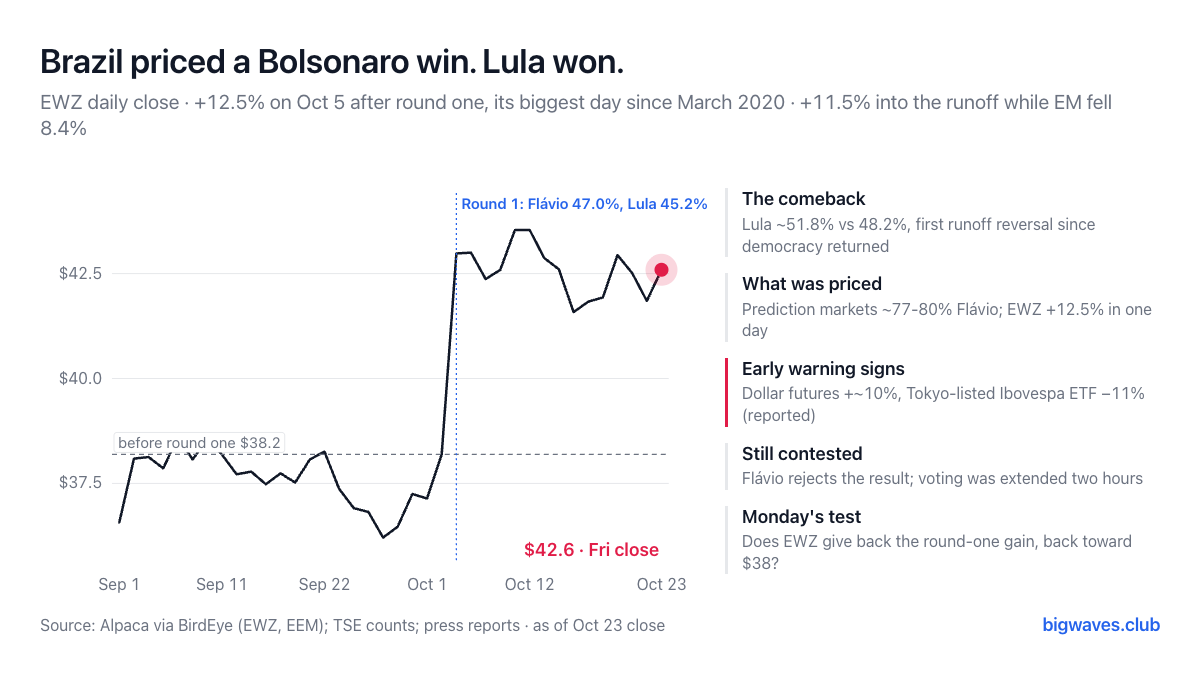 Caption: the US-listed Brazil ETF. The dotted line is the first round; the dashed line is where EWZ closed the Friday before it.
The twists
- Round one, Oct 4: Flávio led. 47.03% to Lula's 45.16%, beating most polls, which had Lula ahead by single digits.
- The market went all in. EWZ rose 12.5% on Monday Oct 5, its biggest one-day gain since March 13, 2020, and the only bigger day since 2016. The Ibovespa set a record close of 209,067 on Oct 9. Prediction markets put Flávio's odds at up to 89%, still about 77% on the eve of the vote.
- Runoff day, Oct 25: chaos. Justice Cristiano Zanin, Lula's former defence lawyer, extended voting by two hours at the request of Lula's campaign after reports of blocked buses. The order arrived as polls were closing, after some machines had already been switched off.
- The comeback. Lula won about 51.8% to 48.2%, a margin of roughly 4 million votes. No candidate who lost round one had won the runoff since Brazil returned to democracy.
- Not over. Flávio Bolsonaro says he does not recognise the result and will challenge it.
Why it matters for markets
- The positioning was one-sided. From Oct 2 to Oct 23, EWZ rose 11.5% while EEM, the broad emerging-markets ETF, fell 8.4% and SPY fell 1.3%. That 20-point gap over EM is the trade now at risk. Source: Alpaca daily closes via BirdEye.
- Investors told us what they expected. In a Citi survey of 73 investors, 80% expected the Ibovespa to fall more than 5% if Lula won. Bloomberg Economics estimated the real would be 11% weaker under Lula than in the base case.
- The rally was a risk premium, not fundamentals. Nothing in Brazil's fiscal accounts changed between Oct 2 and Oct 23. A premium that was priced out on a poll result can be priced back in on an election result.
- Early signals are severe. Before Brazilian markets reopen, The Rio Times reported dollar-real futures up about 10% and a Tokyo-listed Ibovespa fund down more than 11%. That is a single source on thin overnight markets, so treat it as an indication, not a print.
- The real had just firmed. It closed near 4.97 per dollar on Oct 23, its first close below 5 since Oct 12, which leaves room to give back.
What we expect
- Base case (Monday to Friday): EWZ gives back at least half of the round-one gain, closing the week below $40.40 from $42.59 on Friday. Signal it is working: Monday's EWZ close below $40.40.
- Alternative: the drop stops near 5% because Lula moves fast to name a market-friendly finance minister and a fiscal anchor. Signal: EWZ above $40.40 at Friday's close and the real back under 5.30 per dollar.
What would change our mind
- The cabinet. A finance minister with a credible spending rule would cut the risk premium faster than any poll could.
- The challenge. A quick rejection of Flávio's appeal by the electoral court ends the political tail. A drawn-out dispute, or unrest, widens it.
This note is general information and the author's opinion as of the date shown. It is not investment advice and does not consider your situation. The author may hold positions in the securities discussed. Data are from the sources named and may contain errors; past performance does not predict future results. Do your own research.